
From the Depths logo

De profundis clamavi ad te Domine

Humanity's Past and Distant Future

This essay was presented to a gathering of MTA members and visitors in Abidjan, Côte d’Ivoire in November 2025

The word “transhumanism” might sound strange at first. But transhumanism, properly understood, is deeply familiar to anyone raised in the Latter-day Saint tradition.

At its simplest, transhumanism is the idea that human beings can and should use technology to improve the human condition—to overcome our limitations and enhance our well-being. It takes seriously the possibility that we are not finished products but beings in process, capable of becoming more than we currently are.

Sound familiar?

LDS president Wilford Woodruff put it this way:

“If there was a point where humanity in its progression could not proceed any further, the very idea would throw a gloom over every intelligent and reflecting mind. Our heavenly parents are increasing and progressing in knowledge, power, and dominion, and will do so, worlds without end. It is just so with us.”

This is the doctrine of eternal progression. Transhumanism, as we understand it, is simply the application of this principle to our present circumstances. The term comes from the Latin trans, meaning “across” or “beyond.” To be transhuman is not to be static; it is to be in transition. And isn’t that exactly what mortality is?

Read more →

Faith in the Future

A Religious Transhumanist Vision for African Development

This essay was presented at TransVision Abidjan 2025

I want to share a vision of what can happen if we exercise pragmatic “Faith in the Future”—trust in our divine capacity, trust that solutions can be found, trust that others have made it through these crucibles before us.

William James, the great pragmatist philosopher, once wrote about the human capacity and desire for struggle, what he called the “strenuous mood.” He observed that this capacity lies so deep that even without traditional belief, people “would postulate a God simply as a pretext for living hard, and getting out of the game of existence its keenest possibilities of zest.” We see this “strenuous mood” even in secular humanists and transhumanists who work tirelessly for progress. In a way, they are “religious” in their devotion.

Read more →

What Is Intelligence?

Insights from Latter-day Saint Scripture

I gave this presentation at the Organized Intelligence conference, held November 4-5 2025 at the LDS Church Office Building on Historic Temple Square in Salt Lake City.

Medlir Mema, Zach Davis, Will Jones, esteemed Church and social leaders, ladies and gentlemen, we express appreciation to Organized Intelligence, Faith Matters, and Future of Life Institute for gathering Latter-day Saint voices from across disciplines at historic temple square. I am honored to represent the Mormon Transhumanist Association in this timely conference and to explore the ethical, social, and spiritual dimensions of artificial intelligence.

In an age where artificial intelligence prompts us to reconsider fundamental questions about consciousness, cognition, and creation, I’d like to explore what Latter-day Saint theology offers to this conversation—not as definitive answers, but as distinctive insights that might enrich our collective understanding.

My title asks “What is intelligence?” This question has never been more urgent. As we stand at the threshold of potentially transformative AI capabilities, we need frameworks that can help us understand intelligence not merely as computational processing, but as something far richer and more multifaceted.

Read more →

Celestial Forensics

Towards a participatory resurrection

This essay was published in Wayfare Magazine

My friend gripped the steering wheel tighter as we crested another Wyoming hill on I-80.

“So you really believe we’ll all come back from the dead?” he asked, his voice carrying that particular mix of skepticism and hope that I’ve heard in so many conversations about faith.

Outside, the ancient landscape rolled past, layers of rock that had died and been reborn countless times through geological ages, each stratum telling its own story of creation and destruction. I thought of my aunt’s hands, how I could still see them perfectly in my mind, the way they moved the knitting needles with unconscious precision, creating something from nothing with every stitch.

“I think,” I said slowly, watching a hawk circle above the sagebrush, “there will come a day when it’s harder to stay dead than alive.”

He laughed—not mockingly, but with genuine surprise. “That’s quite a claim.”

It was. But as we drove through that vast Wyoming emptiness, I found myself telling him about all the ways we’re already becoming forensic scientists of the sacred, gathering evidence of souls we thought were lost forever.

Read more →

Three Ways of Thinking about the Atonement

Ransom, substitution, and influence

The death of Jesus left his followers devastated. As their promised messiah, they assumed he would deliver Israel from its oppressors in triumph and military might. Imagine their heartbreak when instead they witnessed his humiliating defeat as a common criminal on a Roman cross. From that moment on, every disciple was faced with difficult questions: Was all of this in vain? Was Jesus a failure, or was there some deeper purpose in his apparent defeat?

Among historians there is widespread agreement that the Judeo-Christian concept of a suffering servant, or of a savior who could somehow win by being defeated, was a unique theological innovation that had not been strongly articulated previously in human history. And this concept was destined to go viral in a benighted world that before could only conceive of victory as dominating one’s enemies. Viewed in this new light, the more the Christians were persecuted, the more they seemed victorious, and the stronger they became.

The suffering and death of Jesus has come to be called the atonement in the Christian world. Atonement is a word that was coined by the famous bible translator and Protestant martyr William Tyndale. It is the conjunction of two words, “at one,” with the noun ending -ment. Tyndale was searching for a singular description of this strange act of Jesus whose objective was to reunite humanity with God, to bring each of us, and every person who has ever lived and who will ever live to a state of being “at one” with God, with Christ, and with each other. During his suffering in the garden of Gethsemane, Jesus prayed that we might “all be one, as thou, Father, art in me, and I in thee, that they also may be one in us” (John 17:21).

Along with Tyndale, we are indebted to several prior Christian thinkers who’ve tried to understand this mystery. We sometimes assume that the Restoration wiped the slate clean, but we still owe a great debt to theologians who have gone before us. From that moment of bitter disappointment on Golgotha, Christians have been trying to make sense of the atonement, to explain how it works, so that it can truly have power in their lives and ultimately be brought to pass.

It may seem strange to speak of the atonement as something that hasn’t yet been brought to pass, but Tyndale’s word itself helps us see why it might make sense to speak of it this way. It is painfully obvious that we aren’t yet fully “at one” with God or with humanity, as we witness the cruelty and enmity that so many harbor towards their neighbor, both in our personal lives, in our national discourse, and in foreign affairs. So this word “atonement” reminds us that there is still more work to do.

Read more →

Algorithmic Advent

Great Expectations on the Verge of AGI

This essay was published in Wayfare Magazine

Joseph Smith image generated by the author with MidJourney AI

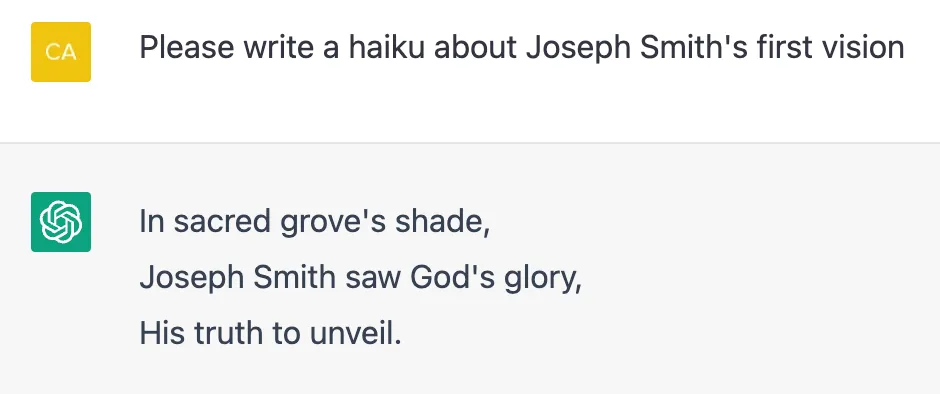
If you’ve been online at all during the past few months, you’ve likely come across anxious discussions about recent innovations in the field of artificial intelligence. The following illustrations show my own interactions with these remarkable new tools. I asked ChatGPT to generate a haiku about Joseph Smith’s first vision. I then made several attempts to coax novel depictions of a young Joseph Smith from a software service developed by independent research lab MidJourney. The results are at times stunning and seem surprisingly artistic for content that is (except for my own prompting) machine-generated.

A recent request made by the author to OpenAI's ChatGPT

Classified broadly as “generative AI,” these new tools have enabled anyone to interact with artificial intelligence to answer questions on a broad variety of topics and to create novel content in the form of articles, essays, news reports, poetry, prose, scripts, screenplays, visual arts, video, and other media. Trained on massive human-curated datasets of text, images, and other publicly-accessible Internet content, the output quality of these tools often mimics human capabilities and can be generated in near real-time.

It is difficult to overstate the consternation caused by these innovations. Garnering mass adoption in the few short months since their release, hundreds of millions of people have been both astounded by their capabilities and concerned over potential disruptions they may cause, not to mention existential threats that future advances may pose to humanity at large. In a moment that may prove civilization altering, I believe there are unique insights in Mormon theology that can inform our exploration of these exciting and disturbing trends. I also believe we have a duty to share these insights ecumenically, helping to promote outcomes that can bring humanity closer to Christ.

Read more →

Web3 and the Promise of Decentralized Governance

This essay was presented at MTAConf 2022: Decentralization of Power

Philosophers and political scientists have long debated the challenge of balanced and sustainable governance. The problem of collective action or preference coordination has kept power sharing limited. For most of recorded history, humanity has been compelled to choose between chaos and tyranny, with power usually concentrated within a relatively small group led by a single dictator. Perhaps surprisingly, political scientists tell us that “bad behavior is almost always good politics,” meaning that dictators who hoard resources and dole them out lavishly to a small cadre of loyal leaders tend to maintain their hold on power better than those who attempt to distribute resources more equitably across a larger number of constituents. This is because resource distribution gets exponentially messier as the number of beneficiaries grows.

Another term used to describe this problem is the tragedy of the commons. As scarce resources are shared between more and more people, it becomes more and more difficult to coordinate them fairly. Inevitably, one person or group of persons begins to take more than their fair share of resources. Others react in kind, and before you know it, the resource has been ruined for everyone.

Traditionally, centralized authorities have been relied upon to govern these scarce resources, carefully apportioning them to those in positions of privilege or power, or those who seem especially deserving. Thomas Hobbes appealed to the necessity of a powerful central authority, a “Leviathan” that was so awe-inspiring and intimidating that nobody would dare to provoke its wrath. Without the pacifying power of the Leviathan, according to Hobbes, life would be “nasty, brutish, and short.” Tribalism and chaos would prevail, because no faction would be sufficiently powerful to prevent others from trying their luck at conquest.

Read more →

Demythologizing Environmentalism

Overcoming the Malthusian Fallacy

This paper was presented at MTAConf 2020.

On a friend’s recommendation, I recently found myself reading Ishmael, a best-selling novel by Daniel Quinn, in which one man’s encounter with a gorilla in captivity leads him on a protracted Socratic dialogue about humanity’s relationship with its environment. It was a thought-provoking and insightful read that left me troubled, not only by its implications but also by its assumptions.

The book points out that many of our attitudes towards history and human civilization are the result of deep-seated anthropocentric narratives, and uses the interesting dichotomy of leavers versus takers to contrast prehistoric humanity’s attitude towards nature from that of its successors. It posits that humanity’s relationship with nature was in a state of relative balance during pre-agricultural times, and that it has been out of balance ever since.

While Ishmael has doubtless made tremendous contributions to our environmental discourse, I believe there are significant problems with its premises that echo many common attitudes in the green movement, and that will need to be corrected if we are to come up with viable solutions to the pressing and very real environmental challenges we face. We will only be able to understand and solve these challenges by factoring in the impact of technological transformation.

Read more →

Redeeming Our Past

Practicing Messianic History

This essay was presented at MTAConf 2019

Transhumanists, like other futurists before them, sometimes make the mistake of viewing history as an inexorable upward march—downplaying present problems and looking forward to a bright and inevitable future full of possibility. This optimism is sometimes the product of privilege. Insufficiently aware of, or altogether oblivious to, the suffering of others, these progressives may ignore or downplay efforts to address societal problems in a naïve faith that technology will cure all present ills.

Indeed, many critiques of Silicon Valley culture focus on its insularity: designing successive social media apps that may be this month’s rage in downtown San Francisco but hardly register a blip in the heartland, the rust belt, or the favela. Some futurists may even actively disdain efforts to promote social justice. As people become increasingly frustrated with the digital divide and the difficulty of consensus-based processes, some use their technological privilege to promote apathy, cynicism, exclusion, nativism, and even fascism. Their autocratic, deterministic, manifest-destiny view of history is one in which historically marginalized groups become less and less worthy of consideration and inclusion.

What we need is a different relationship with history altogether—one that does not merely catalog the past or celebrate its triumphs, but that actively seeks to redeem it. For this, I turn to the work of Walter Benjamin, and to the Mormon philosophical tradition that, I believe, gives his ideas a uniquely powerful resonance.

Read more →

How I Became a Reluctant Radical

“Therefore is the kingdom of heaven likened unto a certain king, which would take account of his servants. And when he had begun to reckon, one was brought unto him, which owed him ten thousand talents. But forasmuch as he had not to pay, his lord commanded him to be sold, and his wife, and children, and all that he had, and payment to be made. The servant therefore fell down, and worshipped him, saying, Lord, have patience with me, and I will pay thee all. Then the lord of that servant was moved with compassion, and loosed him, and forgave him the debt. But the same servant went out, and found one of his fellowservants, which owed him an hundred pence: and he laid hands on him, and took him by the throat, saying, Pay me that thou owest. And his fellowservant fell down at his feet, and besought him, saying, Have patience with me, and I will pay thee all. And he would not: but went and cast him into prison, till he should pay the debt. So when his fellowservants saw what was done, they were very sorry, and came and told unto their lord all that was done. Then his lord, after that he had called him, said unto him, O thou wicked servant, I forgave thee all that debt, because thou desiredst me: Shouldest not thou also have had compassion on thy fellowservant, even as I had pity on thee?” (Matthew 18:23-33)

When we hear this parable, the faults of the servant seem so obvious to us.

How could he be so careless, so unaware of his need for mercy and grace? Unfortunately, all of us, at different times in our lives, seem to find ourselves in the servant's place. As I was asked to share thoughts about ministering in our community, some of my own experiences, where I began to see how I had acted like this servant, came to mind.

I remember, for example, how bad I felt when, as a new kid in my elementary school class, nobody had prepared valentines treats for me, but as I think about it now, I also think of how little concern I had for the absent kid whose valentines treats they ended up giving to me instead.

Read more →